


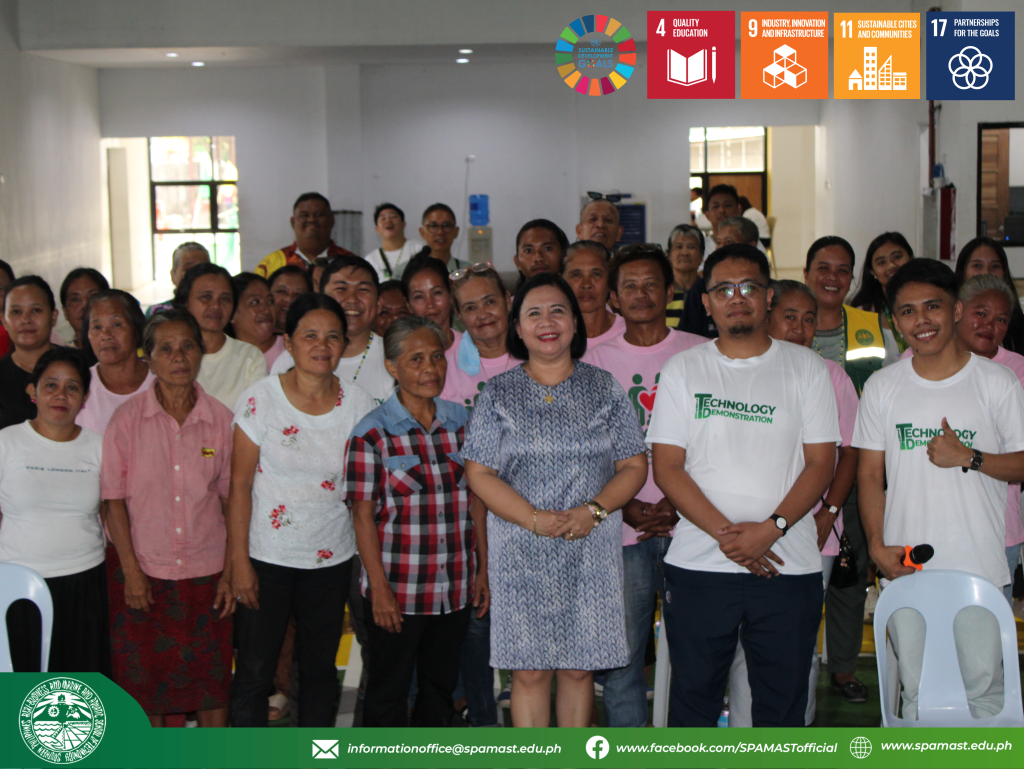
In an era where higher education is called upon not only to generate knowledge but to transform it into tangible social value, the Southern Philippines Agri-Business and Marine and Aquatic School of Technology (SPAMAST) reaffirmed its role as a hub of innovation and community responsiveness through a Technology Demonstration held on February 3, 2026, at 1:00 p.m. at the SPAMAST Founder’s Hall.
The activity, conducted as part of SPAMAST’s 44th Founding Anniversary Celebration, served as an academic platform where student-generated technologies were formally presented to community stakeholders, partner agencies, and institutional leaders. Anchored on the principles of research utilization and extension, the demonstration highlighted how theoretical learning and empirical inquiry can be translated into practical solutions responsive to local and regional needs.
Students from various academic programs showcased technologies developed through research and classroom-based innovation, addressing concerns in agriculture, fisheries, food systems, environmental sustainability, and livelihood development. The presentations emphasized not only technical feasibility but also social relevance, underscoring SPAMAST’s mandate to produce graduates capable of contributing to inclusive and sustainable development.
The event was jointly organized by the Research Development and Innovation Office (RDIO) and the Extension Services Office, illustrating the institution’s integrated approach to instruction, research, and extension. Faculty researchers and technical experts facilitated knowledge exchange between students and community stakeholders, fostering dialogue that strengthens technology adoption and collaborative partnerships.
Through the Technology Demonstration, SPAMAST demonstrated its continuing commitment to academic excellence and societal engagement—positioning research and innovation as vital instruments for community empowerment and regional progress.
This initiative contributes to the attainment of the Sustainable Development Goals, particularly SDG 4 (Quality Education) by promoting experiential and research-based learning; SDG 9 (Industry, Innovation, and Infrastructure) through the advancement of student-led technological solutions; SDG 11 (Sustainable Cities and Communities) by addressing community-based development needs; and SDG 17 (Partnerships for the Goals) by strengthening collaboration between the academe and stakeholders.